Natural Capital Protocol

The Natural Capital Protocol is a decision-making framework that enables organizations to identify, measure and value their direct and indirect impacts and dependencies on natural capital.
Organizations also impact nature’s health, both positively and negatively. Understanding the complex and dynamic relationships that organizations have with the health of natural assets and the ecosystem services they provide enables organizations to make more informed decisions. A capitals approach empowers organizations to deliver benefits their employees, society, the broader economy and the natural world alongside their businesses.
All organizations are dependent on the health of the natural world.

Without an understanding of their impacts and dependencies on natural capital, many decision-makers will be unaware of potentially significant risks and opportunities and will therefore be at least partly ‘flying blind’.
Consequently, they can make decisions that are inefficient, ineffective, or damaging. A capitals approach broadens the quantity and quality of business-relevant information available to decision-makers. Traditionally, the value of natural capital has, for the most part, been excluded from decision-making. Even when included, methods have been inconsistent, open to interpretation, limited to moral arguments or based on an incomplete understanding of organizational relationships to natural capital.
The Natural Capital Protocol responds to this gap by offering an internationally standardized framework for identifying, measuring, and valuing impacts and dependencies on natural capital to inform organizational decisions.
Download here the translations
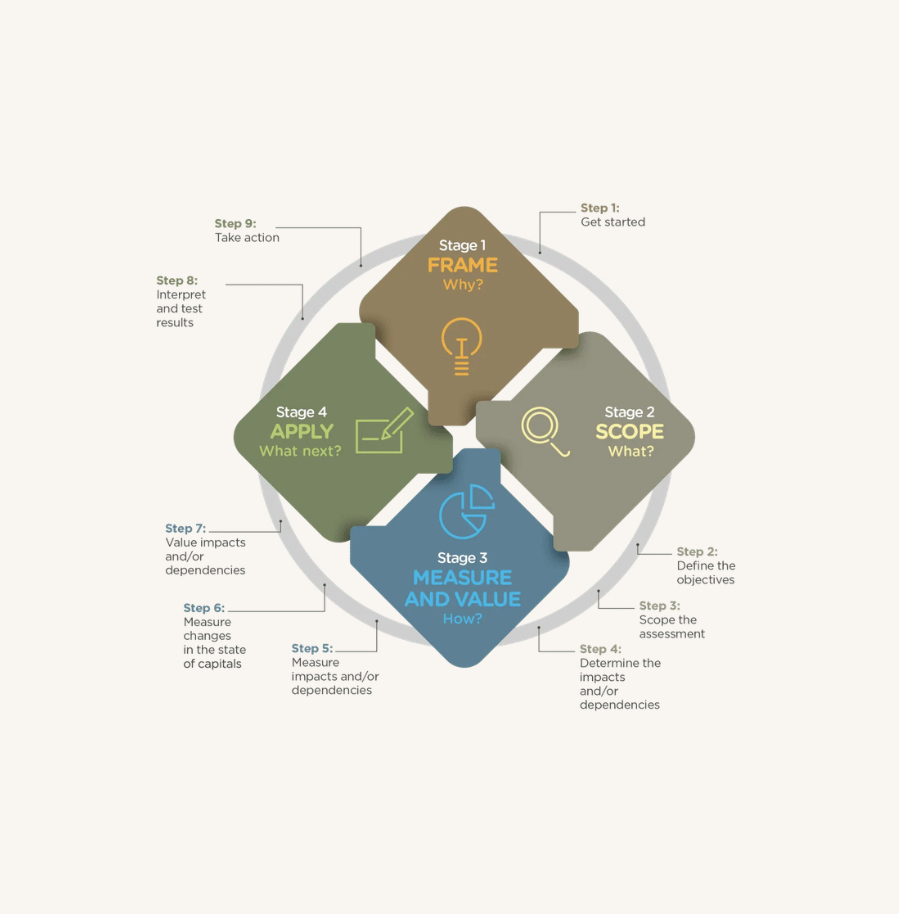
The Protocol Framework covers 4 stages broken down into 9 Steps, each with questions to answer when integrating the value of natural capital into organizational processes.
01 Frame
Identify risks and opportunities for your business and stakeholders resulting from your relationships with natural capital and explore how an assessment would be relevant to decision-making.
02 Scope
Identify the objective of your assessment and conduct a materiality process to select the most relevant impacts and dependencies from the perspective of both your business and stakeholders.
03 Measure & Value
Use relevant approaches to measure and value the costs and benefits resulting from your material impacts and dependencies on natural capital.
04 Apply
Interpret, validate and verify your assessment process and results and integrate them into existing business processes to inform decision-making.
Although presented linearly, the Protocol is iterative and lets users adjust and adapt their approach as they move through the framework.
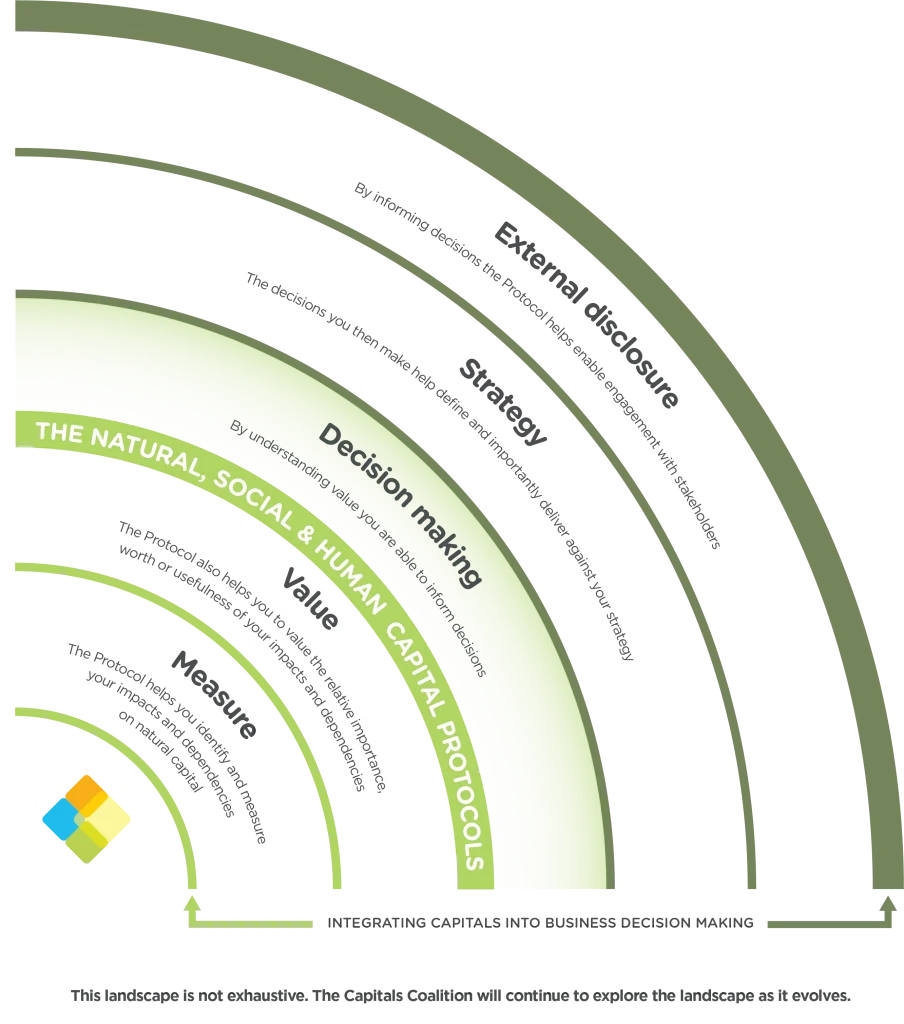
The Protocol is focused on informing business decision-making. It applies to organizations of all sizes across any business sector and operational geography, and it’s also applicable at multiple organizational levels and scopes, for example, at a product, project or organizational level.
It allows to measure, value and integrate natural capital impacts and dependencies into existing business processes such as risk mitigation, sourcing, supply chain management and product design.
Explore Guidelines and Toolkit of the Protocol