Impact Value Standards Board

The Impact Value Standards Board (IVSB) sets the baseline for all future work on Impact Accounting for Value Creation.
The core mission of the Impact Value Standards Board is to empower organizations by providing the tools they need to make more informed decisions. By integrating these practices, organizations gain a profound understanding of the value they create, preserve, or erode through their activities. This holistic view ensures that “value” is no longer a vague concept but a measurable metric that reflects the organization’s true operations.
To drive this change, a common, public-good approach to impact accounting is needed.
When transparency is prioritized, decision-making improves across the board. By standardizing how value creation is understood, we provide leaders with the clarity needed to make informed, responsible choices that benefit both their long-term competitiveness and the overall economy. These solutions are not only business-relevant and pragmatic but also scalable and transferable across diverse sectors.
Our goal is to set a definitive global standard for impact valuation, ensuring that our methodologies are adopted worldwide to create a more transparent and accountable global economy.
Impact Valuation
Why it matters
Impact valuation represents a fundamental shift in how we measure success. It is not about reducing complex issues to a single score, but rather about giving decision-makers clarity and confidence through a more honest and complete view of the risks and opportunities before them.
As organizations navigate ongoing pressures from extreme weather, resource scarcity, workforce challenges, social inequality and economic disruption, they have an increasingly urgent need for trusted data that reflects the real world. Valuing natural, social, and human capitals alongside financial capital, and integrating these insights into financial markets, is key to transforming how we address the social and environmental crises of our time.
What it is
At its core, impact valuation is the practice of translating social and environmental effects into the language of value creation, so that they can sit alongside financial numbers on a balance sheet or in a boardroom conversation, becoming comparable, credible, and usable. It provides a clear and actionable lens through which an enhanced view of long- and short-term risks and opportunities becomes central to financial analysis.
By considering the value being created or destroyed across all capitals, impact valuation gives a fuller picture, providing decision-makers with relevant information to support their actions.
The role of standards
Impact valuation builds on established global standards as it analyzes and acts upon information using the same management systems that are already well understood by firms, investors, and regulators. None of this works if everyone measures differently.
The continuous evolution of impact valuation is a collaborative journey that needs to include diverse perspectives and values. We are committed to a rigorous, respectful exchange to continue evolving the operating system that is transparent and effective in building a resilient economy.
The IVSB builds directly upon the robust standards originally developed by the IFVI with the indispensable contributions of the Value Balancing Alliance (VBA). To ensure that these global standards remain practical and relevant, the Capitals Coalition entered into a strategic partnership with VBA, with a focus on coordinating business voice in the evolution of impact accounting and ensuring industry perspectives shape its development.
Download IVSB Standards
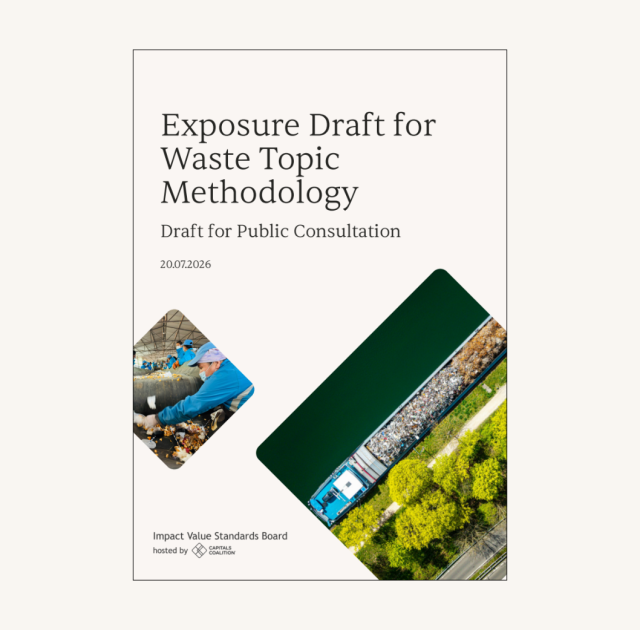
Exposure Draft for Waste Methodology Topic
This draft proposes a standardized methodology for measuring and monetizing waste impacts, following an impact pathway that links waste emissions to changes in the natural environment and, ultimately, to effects on human well-being.
General Methodology 2: Impact Measurement and Valuation Techniques
Water Consumption Topic Methodology

Occupational Health and Safety Topic Methodology


Value factors
In today’s data-rich environment, using value factors, combined with financial, environmental, social, or production data, is increasingly crucial for comprehensive, well-informed, and effective business and financial decision-making. A value factor translates changes in natural, human, social, and economic capital into a number decision-makers can act on, grounded in real data and research.
It shows not just what changed, but how much it matters, so decisions are better informed.
Value factors for impacts and dependencies act as a lens through which businesses can view direct and indirect changes in the well-being people experience caused by shifts in natural, social, and human capital due to organizational or business-related activity. They can be expressed in different ways: with quantitative metrics, monetary, such as lost wages due to poor health from pollution, or non-monetary, such as changes in life satisfaction due to training programs. They can also use qualitative metrics implying descriptive terminology of impacts experienced by different individuals or groups.
Global Value Factors Database
The IVSB has within its mandate the development of a common and comprehensive Impact Valuation Methodology. As a result, IVSB maintains the Global Value Factors Database (GVFD), a centralized resource for environmental and social value factors to enable organizations to value the most significant environmental and social impacts in monetary terms.
The IVSB is also developing user guides to help organizations select the right methodologies and navigate available value factors appropriate for their specific context and needs.

Non-exhaustive list of providers of publicly available value factors.
- GIST Impact and WifOR Institute have teamed together to make a selection of their factors publicly available. These factors are developed specifically with business in mind. They are available at a country and regional level. They cover all four capitals, across 25 countries, and are broken down into the following 20 categories:
Natural Capital: GHG Emissions; Water Use; Waste Generation; Plastic Waste & Pollution; Land & Water Pollution; Air Pollution; Biodiversity and Ecosystem Services.
Human Capital: Training; Health & Safety; Fair Wages.
Social Capital: Diversity, Equity & Inclusion; Community Investment / CSR; Child Labor; Forced Labor; Inclusive Green Economy Business Model Features.
Produced Capital: Employee Compensation; Depreciation & Net Rent; Net Interest; Profits; Tax.
For support on using the factors and to find out more, contact info@gistimpact.com, dialogue@wifor.com - The Ecosystem Service Valuation Database is the largest freely accessible database of monetized natural capital value factors containing over 10,800 unique values. Covering ecosystem services in all biomes on all continents, it is based on over 30 years of peer-reviewed academic research and official reports. The value factors provided here have been used in many situations by businesses NGO’s and government agencies.
- The Global Value Exchange is a crowdsourced database of value, outcomes, indicators, and stakeholders, covering social and human capital. It is a searchable database that lists common indicators and their sources. The Global Value Exchange was founded by Social Value UK, Edge ThreeSixty and the Nominet Trust in 2015.
- The Environmental Prices Handbook developed by CE Delft (Netherlands). The corresponding tool gives the environmental prices of over 3,400 substances, for emissions from an average emission source at an average location in the Netherlands. The prices are per kilo emission in Euros. The most recent methodological update is available for Environmental Prices for the Netherlands, explained and presented in the Dutch Environmental Prices Handbook 2023. The most recent Environmental Prices for the EU are in the 2018 update of EU28 prices. Environmental prices of many common substances can be found in the handbooks.
- The Handbook Value Factors – Methodological Convention has been published by the German Environment Agency since 2007 and includes science-based value factors for environmental impacts on climate, air pollution, nitrogen emissions and others, and applies them to sectors like energy generation, transport and construction. The latest version 3.1 is from 2020, version 3.2, with updated climate costs, has just been published and a fully updated version 4.0 is expected in 2025. Value factors are developed for Germany but can be applied to countries with similar economic and environmental conditions.
- Valuing Impact published its impact valuation method, eQALY, developed over the past 10 years together with a range of multinational businesses, impact investors and family offices. The eQALY method includes a full range of valuation factors covering social, human, and natural capital. Natural capital valuation factors are regionalized and available for all countries in the world, and cover 19 different impact drivers. Human and social capital built mainly on the Health Utility of Income and Taxes publications. The dataset includes other data supporting the estimation of outcomes, such as earning premium from education and wages per skill level worldwide. Finally, all this dataset is embedded in an Excel tool template that allows to easily replicate the modeling for any activity, based on the template used across thousands of modeling done by Valuing Impact team. For more information contact sv@valuingimpact.com
- True Price Foundation has established a scientifically and normatively sound methodology to translate environmental and social footprints into comparable monetary values. Their open-access database provides standardized value factors for 76 indicators for 10 social and 10 environmental true price impacts. By grounding complex environmental data and social research into clear value factors, this framework allows organizations to look beyond traditional financial metrics, identify systemic risks, and make holistic decisions that reflect the true cost of products. The monetization factors are accompanied by method modules for Natural, Human and Social capital, available on the website of the True Price Foundation.
Natural Capital: Includes value factors for greenhouse gas (CO2) emissions, scarce water use, air, soil and water pollution, soil degradation, land use and land-use change, and resource depletion.
Social & Human Capital: Covers critical socio-economic metrics including underpayment, child labor, forced labor, and more labour and human rights violations.
Please note that some may require subscriptions, others are readily available. This list should not be interpreted as an endorsement. The Capitals Coalition has not conducted a formal review or quality assessment of these sources.
IVSB Governance and Structure
The Impact Value Standards Board represents a unification of the independent Value Commission (2023-2025) hosted by Capitals Coalition and the Valuation Technical & Practitioners Committee (VTPC) (2022-2025) of International Foundation for Valuing Impact (IFVI) and has 26 members, of which 1 is chairperson and 2 are vice-chair. The IVSB serves as an independent governing body dedicated to building international consensus and establishing a global common baseline for impact valuation.
To learn more about the selection criteria for members and the general procedures of the Committee, please see the Terms of Reference, which describe the role, mandate, and composition of the IVSB and its relation to the rest of the governance structure. To learn about the process for methodology development, including research, stakeholder engagement, and public comment, see the Due Process Protocol.
As part of our commitment to transparency, all IVSB meeting agendas and minutes are made public.
IVSB Architecture and Workplan
The IVSB marks a pivotal advancement in impact valuation, grounding its future-focused evolution in a legacy of proven success.
In 2022, the International Foundation for Valuing Impacts (IFVI) and the Value Balancing Alliance (VBA) collaborated to develop a rigorous, global Methodology for impact accounting. Developed through the integration of regulatory requirements, academic research, and practical user feedback, and refined by expert stakeholders and international standard-setters, this Methodology serves as a public good to enable companies, investors, regulators, and policymakers to make better decisions that drive impact. Indeed, whether used for corporate management or portfolio allocation, these standards empower companies, investors, and policymakers to move beyond traditional reporting toward true value-based decision-making.
This legacy, together with the three methodologies displayed above, forms the core foundation of the IVSB’s work. See the IFVI website for an overview of the available methodologies. These include both methodologies that have been adopted through a robust due process, as well as interim methodologies that have not yet followed such a process but have proven to be consistent and relevant for business.
Triple mandate
1. Valuation Governance Framework
To oversee the development of a governance framework for valuation that organizations can consistently apply to build confidence in the development and use of methods of valuation.
2. Impact Valuation Methodology
To develop and expand a common and comprehensive Impact Valuation Methodology for value creation, including standardized pathways and value factors.
3. Implementation Advisory & Guidance
To advise on and provide consistent guidance on implementation and best practices for valuation.



Members

Richard Andrews
Head of ESG and Partner, KPMG

Tom Beagent
Partner, PwC

Ben Bowie
Managing Director, TMP Public

Charlotte Drain
Partner, Deloitte UK

Tiffany Finley
Director, Impact Profit & Loss and Intelligence, Target Corp

Sonja Haut
Head Strategic Measurement and Materiality, Novartis

Christian Hell
Partner, EY

Christian Heller
CEO, Value Balancing Alliance and Vice President, BASF SE

Dr. Xu Hu
Head of Research, Chinese Academy of Financial Inclusion

Astrid Matthey (Observer)
Senior Economist, German Environment Agency

Ken McPhail
Dean, Alliance Manchester Business School (AMBS)

Kathy Mulvany
Global Head of Sustainability, Pure Storage

Carl Obst (Observer)
Director at Institute for the Development of Environmental-Economic Accounting (IDEEA)

Joonwhan Oh
Vice President, SK & Senior Executive Researcher, CSES

Dennis Ostwald
Founder and CEO, WifOR Institute

Karan Peer
Director, GIST Impact

Vincent Siegerink
Senior Technical Specialist, TISFD/OECD

Helen Slinger (Observer)
Executive Director, A4S

Samuel Vionnet
Founder and Director, Valuing Impact

Dirk Voeste
Chief Sustainability Officer, Volkswagen Group

Sebastián Welisiejko
Chief Policy Officer, GSG Impact

Gefei Yin
Founder and Chief Expert, GoldenBee (Beijing) Management Consulting Co.
Explore our Resources
With the aim of embedding nature, people and society in decision-making, the Capitals Coalition continues to develop resources to provide individuals and institutions with access to knowledge, skills, and tools.